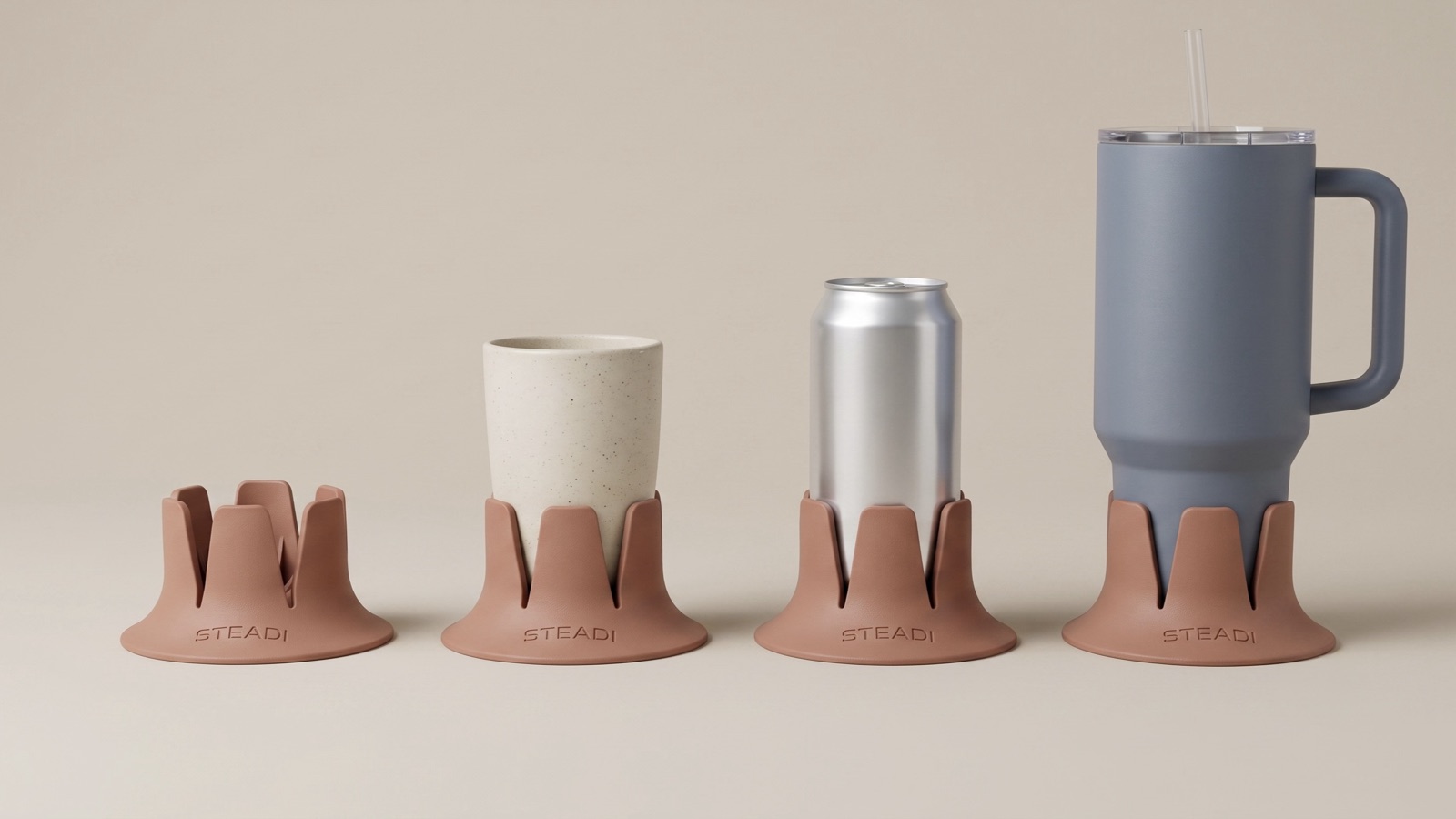
A flexible base that holds your can, bottle, or tumbler steady on whatever the site gives you — dirt, grass, gravel, sand — beside the chair at the fire ring, on the tailgate, and next to your sleeping pad at night.
One flexible base. Shown empty, then with a cup, a can, and a 40 oz tumbler — one footprint, the same grip on each.
The situation
You've been improvising this at every site.
Pocket, dirt, tailgate, table — the drink gets re-homed a dozen times a trip, and every landing spot is a compromise you've stopped noticing you make.
The armrest pocket.
The mesh ring that came with the chair, sized around a bare 12 oz can. The insulated bottle doesn't fit, the koozied can doesn't clear, and the slack fabric has tipped out enough bottles that reviewers list it as a flaw, not a feature.
The ground beside the chair.
The default: balanced in the grass, propped against a chair leg, standing in the dirt at boot height — exactly where the dog, the kids, and the next armload of firewood all pass through. At the beach it comes back carrying sand.
The picnic table.
It sits where the campground put it, not where your chairs circle the fire — and that's when you get one at all. Dispersed sites don't come with a table, and the ones that exist are a gamble: wet, warped, burn-scarred, or cold concrete.
The tent floor at night.
The water bottle stands on slick coated fabric right beside your sleeping bag — the one spot where knocking it over isn't a mess but a gear problem, because a soaked bag takes days to dry in the field.
No single one of these wrecks a weekend. But the improvising follows you from site to site, all trip long — and you've stopped counting how often you do it.
You know the moment
Same trip, every trip.
Friday, twenty minutes in
The site looked level from the truck. First chair down, one skinny leg finds the soft spot, the whole rig lists — and the drink riding in the armrest pocket leans right along with it.
Saturday afternoon
The can fits the koozie or it fits the pocket — not both. So the koozie stays in the bin, the can sweats warm in your hand, and eventually it ends up standing in the grass against a chair leg.
The beach stop
The bottle goes down into soft sand at whatever angle the sand decides. When you pick it back up, you check the rim before you drink — everyone who's taken that gritty last swallow checks the rim.
2 AM, in the tent
Thirsty, patting the dark for the bottle, moving slow on purpose — because a bottle knocked over on a bathtub floor doesn't soak in, it travels, and it's aimed at your sleeping bag.
What you get
Three reasons it stays out.
01
Stands steady on ground that isn't
The wide flexible base spreads its footprint across dirt, grass, gravel, or sand instead of punching in the way a chair leg does. The site can slope, the sand can shift — the base gives with the ground underneath, and the drink settles back level.
02
Holds what the cooler run brings back
The can, the glass bottle, the lidded water bottle, the 40 oz tumbler — whatever comes back from the cooler drops through the fins and gets gripped by its bottom inch. No mesh pocket deciding what you're allowed to drink.
03
Packs like it camps
One piece of matte flexible material with no legs, no stake, no hardware — nothing to assemble at the site, nothing to fray at a screw. It rides flat in the chair sleeve or the camp bin, shakes off dirt, and rinses clean at the spigot.
The fit test
One sticky note settles the packing list.
your cup's base lands in here
A square sticky note: 3 inches, exactly.
01
Grab a sticky note.
The standard square measures exactly 3 inches on a side — that's a fact about sticky notes, not a spec sheet, and it doubles as the exact ceiling of what fits.
02
Stand the bottle on it.
Use the one that's actually going in the bin — and look at its base, not its shoulder or its lid. Bottles and tumblers taper and flare; the bottom is the only part the fins ever meet.
03
Read the square.
Base lands inside the square? It fits. Hangs over the edge? Too wide. A little puck adrift in the middle — under about 2 inches? Too narrow.
No calipers, no gear-forum deep dive, no guessing in the driveway. One sticky note at the kitchen counter, with the bottle you actually pack.
Will it fit my cup
Measure the bottom, not the top.
The rule packs light: a container base about 2 to 3 inches across settles in. Each verdict below is just that rule applied.
Stanley Quencher 40 oz fits
Yeti Rambler 30 oz fits
Standard 12 oz can fits
16 oz tallboy can fits
Slim seltzer can fits
Glass beer bottle fits
Lidded water bottle fits
Camp cup, no handle fits
Kids' straw cup fits
Nalgene 32 oz wide-mouth too wide
Wide-mouth thermos too wide
Enamel camp mug, handled handle in the way
The floor matters as much as the ceiling — under about 2 inches the base sits too loose. The honest misses are the big wide-mouths: a base that hangs over the sticky note is too wide. And the enamel mug is the classic exception — its base is fine, but the handle lands exactly where a fin needs to grip.
How it works
Three parts, no moving parts.
Wide beats pointed.
Soft ground swallows anything narrow — that's why skinny chair feet sink one at a time. The wide flexible base does the opposite: it lays its weight across the dirt, sand, or gravel instead of pressing a point into it.
The fins take hold.
Inside the base, flexible fins take the drink by its bottom inch and hold it from the sides — so a bump from a boot, a dog, or a dragged cooler doesn't rattle it loose.
The ground moves; it settles.
The sand compresses, the slope announces itself, somebody scoots their chair closer to the fire — and the base moves with the ground, settling the drink back level.
Nothing stakes into the ground. No spike to stomp into soil that may turn out to be gravel or rock, no clamp on the chair frame, no legs to shim level. It sits on top of whatever the site actually is, moves when your chair migrates around the fire, and packs flat when the tailgate closes.
Ground truth
Five surfaces at every site — none of them on your side.
It isn't carelessness. Everything out there is soft, sloped, sized for a bare can, or slick enough to send a spill traveling.
The armrest pocket
A floppy ring of mesh sewn into the chair's own fabric, cut around a standard 12 oz can. Reviewers keep reporting the same endings: bottles and cans tipped out of the slack material, insulated bottles that won't drop in, koozied cans that won't clear, and fabric that frays where the mounting screw holds it.
The ground itself
Dirt, grass, gravel, sand — and rarely level, even when it looked it from the road. A can standing in grass has no flat footing, a slope tips whatever the chair legs don't, and at the beach the drink comes back seasoned with sand.
The chair on soft ground
Skinny legs built for packability concentrate all the weight into four small points, and points sink. One foot goes down first, the chair tilts — and whatever's riding in the armrest tilts with it.
The picnic table
Fixed wherever the campground set it, not where your chairs face the fire — and its condition is a coin flip: wet, warped, burn-scarred, or bare concrete. At a dispersed site there simply isn't one.
The tent's bathtub floor
Coated nylon or polyethylene running up the walls like a tub — waterproof both directions, so nothing soaks in. A bottle knocked over at night sends its contents skating across the floor toward your sleeping bag, and a soaked bag takes days to dry in the field.
Versus what you do now
Up against everything already in the bin.
The chair's built-in cup holder
The one sewn into the armrest. Reviewers keep landing on the same list: it tips water bottles, cans, and glass bottles out of its slack fabric; it's cut for a naked 12 oz can, so the insulated bottle, the wide-mouth thermos, the koozied can — even a sippy cup — won't fit; and it frays and tears at the mounting screw. Worst of all, it rides the chair — when a leg sinks, the drink goes with you.
The drink stake
The spike-in-the-dirt holder solves the armrest and trades it for the soil. By the makers' own instructions it has to be pressed or stomped into penetrable ground — which rules out the gravel tent pad, the hardpack, and the rock slab a lot of sites turn out to be. And it stands wherever the spike went in, not wherever your chair has migrated.
The folding camp table
Solves the tableless site and adds a real haul in exchange. The light ones aren't stable — campers report the lightweight plastic ones tip right over the moment nothing is weighing them down — and only the adjustable-leg models cope with a slope at all.
Shimming the chair legs
The forum catalog of leveling fixes — scrap 2x4s, plastic containers, little platforms under each foot — amounts to packing lumber to a campsite, and it starts over each time you scoot toward the fire. Even the mats only help on ground that was semi-soft and mostly even to begin with.
Before you buy
Questions people actually ask.
Does it actually work on dirt, grass, and sand?
That's its home ground. Soft and uneven surfaces are what the shape was drawn for: the wide flexible footprint spreads across dirt, grass, gravel, or sand instead of sinking the way a narrow base — or a chair leg — does, and the fins keep the drink from rattling loose when the ground gives. Tilt the ground under it and it settles back.
What about a gravel tent pad or bare rock?
Yes — it works at least as well on hard surfaces as on soft ones. Nothing has to drive into the ground, so the gravel pad, the hardpack, and the rock slab that defeat a drink stake are all fair footing.
Will my bottle fit?
Measure the bottom, not the shoulder. A base about 2 to 3 inches across settles in — the 40 oz Stanley fits. The big wide-mouths are the ones to check with a sticky note before you pack, and handled mugs don't fit — the handle gets in the way of the fins.
Does anything stake in or clamp on?
No. No spike to stomp into the soil, no clamp on the chair frame, no assembly at the site. It sits on top of whatever's there and picks up in a second when the chair circle shifts.
Can I use it on the picnic table too?
Yes — the wide footprint and the grip work at least as well on a hard tabletop, which is worth having on a warped, crowded, or tilted table. And at a dispersed site with no table at all, the ground beside your chair becomes the table.
What about inside the tent at night?
That's the quiet win. The bathtub floor is slick coated fabric, so a knocked-over bottle sends water straight toward your bag. Standing the bottle in the base beside your sleeping pad means the 2 AM reach finds it upright — it resists tipping and settles back when you shift. It isn't a sealed lid, so keep using a lidded bottle at night and you've got both layers.
My chair is tippy on soft ground. Doesn't the drink just go with it?
Only if the drink is riding the chair — that's the quiet flaw of the armrest pocket. This sits on the ground on its own wide footing, so the chair can lean all it wants. It resists tipping; it doesn't repeal physics — a square kick from a boot is still a square kick. But ground going soft or sloped underneath, the very thing that tips chairs, is the job it was shaped for.
How do I clean it after a weekend in the dirt?
Shake it out, rinse it at the spigot, or run it through the dishwasher at home. It's one piece of flexible injection-molded material — no fabric to fray, no screw to work loose, nothing to come apart in the bin.
How much pack space does it take?
About none that matters. It's one flat, flexible piece with no legs or hardware — it slides down the side of the camp bin or into the chair's own carry sleeve.
Who makes it, and where do I buy one?
It's called the Steadi, injection molded in small runs in Orange, California by Steadi Labs — veteran-founded and patent pending. Every order ships free from steadilabs.com, with 30 days to change your mind.
Who makes it
Made start to finish in Orange, California.
The maker is Steadi Labs, a small veteran-founded company in Orange, California. It's injection molded — the mold, the material, and the color runs all sit within about three and a half miles of the shop, and every batch is molded there in small runs. The people who make it are the same people who answer hello@steadilabs.com.
Thirty days, wherever you use it.
Use it for a month. If it doesn't do what this page says, email hello@steadilabs.com and it gets made right — no forms, no fight.
Veteran-founded · Patent pending · Made in Orange, California
Keep the drink out of the dirt.
The drink stands level beside your chair, on whatever ground the site turned out to be — and the fire gets your attention back.